

Introduction
If you want a fully funded master's in Europe starting September 2027, the application window is open right now: most Erasmus Mundus Joint Master (EMJM) programmes accept applications between October 2026 and January 2027.
I was an Erasmus Mundus scholar from 2021 to 2023 in the Smart Systems Integrated Solutions (SSIs) programme, studying across three European universities. Since then, many of you have written to me with questions. This post is my updated, one-stop guide for the 2027 intake, built on the official Erasmus+ information and my own experience.
An EMJM is a joint master's degree designed and delivered by at least 3 universities in at least 3 countries. You study in two or more countries, often do a thesis or internship with an industry or research partner, and graduate with a joint or multiple degree. The programme lasts 1 to 2 years (60, 90 or 120 ECTS).
What's new for 2027: on 16 July 2026, the European Commission selected 37 new Erasmus Mundus Joint Masters. They open applications in autumn 2026 for a September 2027 start, on top of the programmes already in the catalogue. New fields include medical image analysis, semiconductor chip integration, law, data and AI, and infectious diseases and One Health.
What the scholarship covers
The EMJM scholarship pays €1,400 per month for the whole programme and waives all tuition and participation costs. For a 24-month programme, that is €33,600 in allowance alone, with no work or bond commitment afterwards.
| Item | What you get |
|---|---|
| Monthly allowance | €1,400 per month, for the full programme duration (max. 24 months) |
| Total allowance (24 months) | €33,600 |
| Tuition and participation costs | Fully waived for scholarship holders (often worth €4,500–€9,000 per year) |
| Insurance | Usually included in participation costs; check your programme |
| Travel, visa, installation | Paid from the monthly allowance, not as separate grants |
| Application fee | Selected EMJM programmes cannot charge one |
| Students with special needs | Extra EU support for documented disability-related costs |
One change from older guides: there is no longer a separate travel grant or different rates by nationality. Everything (travel, visa, rent, food) comes out of the single €1,400 monthly amount. Some consortia pay part of it as an advance for travel and visa costs, so check your programme's payment rules.
In my experience, €1,400 is comfortable in most European cities if you budget carefully. In expensive cities like Helsinki, Oslo or Paris, rent will take a big share, so check housing early.
The monthly amount is set by the EU and is the same in every programme. The full funding rules are in the Erasmus+ Programme Guide.
Who can apply
Students of any nationality can apply, including from Bangladesh, India, Pakistan, Africa and Latin America. The EU's basic requirements are short:
- A bachelor's degree, or be in the final year of your bachelor's and graduate before the master's starts
- Alternatively, a recognised bachelor-equivalent level of learning, accepted in the degree-awarding country
- You have not already received an EMJM scholarship before (one EMJM scholarship per person)
Each consortium then adds its own academic requirements: a related bachelor's field, a minimum CGPA, English proof (often IELTS 6.5 or equivalent; some waive it for English-medium degrees), and sometimes work experience or a portfolio. Always read the eligibility page of each programme before applying.
There is no age limit set by the EU. Work experience is not required for most programmes, but relevant research, internships or jobs strengthen your profile.
Timeline and deadlines for the 2027 intake
There is no single deadline: each programme sets its own, and most scholarship deadlines fall between late November 2026 and February 2027. Here are four technology programmes with confirmed 2027 application windows, if you work in batteries, energy or AI:
| Programme | Field | Countries | 2027 application window |
|---|---|---|---|
| i-MESC | Batteries and materials for energy storage and conversion | France, Spain, Slovenia, Poland (plus partners in the USA and Australia) | 9 Nov 2026 – 26 Jan 2027 (indicative) |
| DENSYS 2.0 | Decentralised smart energy systems | France, Sweden, Italy, Spain | 12 Oct 2026 – 27 Jan 2027 |
| EU-CORE | Renewables-based power systems | France, Germany, Croatia | Scholarship applications 1 Nov 2026 – 31 Jan 2027 |
| AISS | Artificial intelligence for sustainable societies | Estonia, Finland, Portugal | 2 Dec 2026 – 2 Feb 2027 |
Always confirm on the official page before applying, as consortia sometimes adjust them.
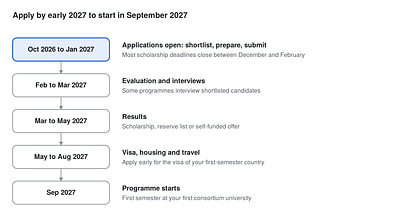
The self-funded deadline is often months later than the scholarship deadline. If you want the scholarship, the earlier date is the one that counts.
How to choose your programmes
You can apply for the scholarship in up to 3 EMJM programmes per application round, so choose them carefully. There is no central portal: you apply directly to each consortium.
- Open the official Erasmus Mundus Catalogue and filter by your field. Ignore unofficial lists; they are often out of date.
- Shortlist 6–10 programmes that match your bachelor's subject and career goal.
- Check each programme's website for: the 2027 intake, the scholarship deadline, minimum CGPA, English test, and required documents.
- Keep the 3 where your profile fits best. A strong fit beats a famous name.
- Look at the newly selected 2027 programmes too. In their first intake, they are less known and can be slightly less competitive.
A tip from my own application: I chose programmes where my bachelor's thesis, research assistant work and industry job told one clear story. That story is what the selection committee reads.
Documents you will need
Most programmes ask for the same core set. Start collecting these now, because attestation and recommendation letters take the longest.
- Valid passport (scan of the photo page)
- Bachelor's degree certificate, or a letter confirming expected graduation
- Academic transcripts, with an official grading-scale explanation
- Certified English translations, if your documents are not in English
- English proficiency proof (IELTS, TOEFL, or a medium-of-instruction letter if accepted)
- CV, usually in Europass format
- Motivation letter, tailored to each programme
- 2 recommendation letters (academic, or one academic and one professional)
- Proof of residence (some programmes ask for it to apply EU or non-EU fee rules)
- Optional extras: publications, certificates, portfolio, research proposal
For Bangladeshi applicants: get your certificates attested early through myGov, the Ministry of Education and the Ministry of Foreign Affairs. My Scholarship Resources page has templates for the CV, motivation letter and recommendation letter.
Step-by-step application process
- Shortlist up to 3 programmes from the official catalogue (see above).
- Read each programme's website fully: eligibility, deadline, required documents, and how they define "scholarship applicant".
- Take your English test if needed. Book IELTS or TOEFL early; results can take 2 weeks.
- Request recommendation letters at least 4–6 weeks before the deadline. Give your referees your CV and a short note on each programme.
- Write a separate motivation letter for each programme. Name its courses, universities, mobility track and partners, and connect them to your goal.
- Fill in the online application on the consortium's own portal and tick the option to be considered for the Erasmus Mundus scholarship.
- Submit before the scholarship deadline, not the later self-funded deadline. Aim for at least a week early.
- Prepare for an interview, which some programmes hold in February–March.
- Wait for results, usually from March to May: selected, reserve list, or self-funded offer. Reserve-list candidates are often upgraded, so do not lose hope.
- Accept, then start the visa process for your first-semester country as soon as you receive your documents.
Tips to strengthen your application
The scholarship is highly competitive, but committees reward clear, specific applications, not perfect grades alone.
- Make the motivation letter programme-specific. A generic letter sent to three programmes is easy to spot. Explain why this consortium, these universities and this specialisation.
- Show a coherent story. Link your bachelor's work, projects, jobs and future plans in one line of reasoning.
- Quantify your experience. "Tested 40 supercapacitor cells over 6 months" says more than "worked on energy storage".
- Choose referees who know you well. A detailed letter from a supervisor beats a vague one from a famous name.
- Follow the format exactly. Word limits, file names and PDF rules matter. Incomplete files are often rejected without review.
- Mention your return or impact plan. Committees value candidates who will use the degree to contribute back home or in their field.
- Talk to alumni. The Erasmus Mundus Association and alumni on LinkedIn are usually happy to answer questions.
- Apply even if you doubt yourself. Many scholars almost did not apply.
If you want feedback, I review documents through my Document Review page.
Frequently asked questions
Is there one deadline for all Erasmus Mundus programmes? No. Each consortium sets its own. Most 2027 scholarship deadlines fall between late November 2026 and February 2027.
How many programmes can I apply to? Up to 3 EMJM programmes per application round for the scholarship.
Is there an application fee? Selected EMJM programmes may not charge one. If a website asks for payment, double-check you are on the official programme page.
Do I need IELTS? Most programmes want IELTS 6.5 or equivalent. Some accept a medium-of-instruction letter from an English-taught bachelor's. Check each programme.
Can I apply in my final year of bachelor's? Yes, as long as you graduate before the master's begins in September 2027.
I didn't get the scholarship. What now? You may receive a self-funded offer or a reserve-list place. You can apply again the next year, and many successful scholars did exactly that.
Can I work while studying? Usually yes, within the student work limits of each host country. Check the rules of each country in your mobility track.
Final words
The Erasmus Mundus scholarship changed my career: it took me across three European universities and led directly to my research path in battery technology. The application costs you nothing but time and effort, so start today: shortlist your programmes this week and request your recommendation letters this month.
More from my website:
- Master's Scholarship Resources: CV, motivation letter and recommendation letter samples, plus useful links
- Document Review: get feedback on your application documents
- Schedule a 20-minute meeting with me
Good luck with your 2027 application!