

Every engineer who models batteries faces a dilemma: you can build a model that captures, in fine detail, the chemistry unfolding inside a cell, but it runs so slowly that simulating a battery's whole life becomes impractical. Or you can build one that runs in the blink of an eye, yet is effectively blind to what is actually happening inside. For years, you had to choose between accuracy or speed.
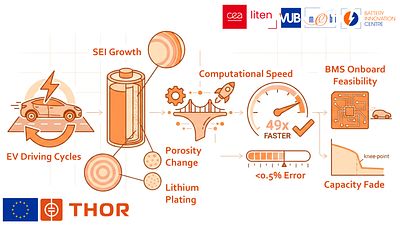
A new study from the THOR consortium shows a way to have both. Researchers from the MOBI- Electromobility Research Centre at Vrije Universiteit Brussel and CEA LITEN (Grenoble) have developed a lightweight battery model that carries the physical “knowledge” of a far heavier one, and tracks how a battery ages around 49 times faster, without losing accuracy. The work has been published in the IEEE Open Journal of Vehicular Technology.
What wears a battery out
To see why this matters, it helps to know what ages a battery. Two processes dominate: the first is the slow growth of a microscopic layer called the SEI (solid-electrolyte interphase) on the graphite electrode, a protective crust that forms as the battery is used, consuming the lithium that stores energy. The second is lithium plating: instead of intercalating neatly into the electrode, lithium deposits as metal on its surface. This tends to happen under harsh automotive conditions, such as fast-charging or heavy regenerative braking at low temperatures. Crucially, the two processes feed each other, producing the sudden, non-linear ageing seen in real electric-vehicle batteries.
Capturing that coupled behaviour accurately is exactly what detailed physics-based models (known as DFN, or Doyle-Fuller-Newman models, the similar type of model THOR is building) do well, but they are far too slow to run inside the onboard systems (the battery management system, or BMS) that watches over a battery in a moving car.
A virtual laboratory for a faster model
THOR’s approach uses the detailed DFN model as a “virtual laboratory”: it runs a battery through controlled virtual experiments and reveals precisely how the SEI grows, how lithium plating begins, and how internal resistance rises. An optimisation algorithm then translates that physical understanding into the settings of a much simpler, faster model.
The result is what the team calls a physics-informed reduced-order lumped (PIROL) model. Unlike conventional fast models, whose parameters are essentially fixed guesses fitted to data, PIROL’s parameters stay tied to real electrochemistry. The growth of internal resistance, for instance, is linked to the actual thickness of the SEI layer computed by the detailed model. It has the speed of a lightweight model and the physical awareness of a heavyweight one.
Fast, and faithful
Tested on prototype 21700 cylindrical cells (NMC-622/graphite) under a range of real-world driving profiles (including the aggressive highway and stop-start patterns), the model tracked voltage with an error consistently below 0.50%, matching the detailed benchmark while running around 49 times faster. In one telling test, it simulated a continuous 16-hour driving profile that the detailed model simply could not complete in reasonable time, a strong sign that it is ready to run continuously, onboard, under real conditions.
Knowing the limits
For the first several hundred charge-discharge cycles, the simulation follows real cells closely. The model captures the overall degradation trend well, although physical prototype cells eventually exhibit a “knee point” characterized by a more rapid capacity decline. When the team took an aged cell apart, they found the probable causes: heavy build-ups of plated lithium, localised drying-out of the electrolyte and uneven SEI growth. These abrupt, late-life failures are the next challenge for future work.
This is a concrete step towards THOR’s central goal: a battery digital twin accurate enough to trust, yet fast enough to use in real-word settings. By showing that high-fidelity physics can be preserved at real-time speed, the work brings closer the day when much of today’s slow, costly physical testing can be done virtually, helping European battery developers move from years of trial-and-error towards hours of simulation.

Contributing researchers:
- Rashid Ahmed Rifat , MOBI, Vrije Universiteit Brussel
- Marion Chandesris, French Alternative Energies and Atomic Energy Commission (CEA)
- Alexis Martin, French Alternative Energies and Atomic Energy Commission (CEA)
- Chau Cam Hoang Tran, French Alternative Energies and Atomic Energy Commission (CEA)
- Justin Bouvet, French Alternative Energies and Atomic Energy Commission (CEA)
- Jiacheng He , MOBI, Vrije Universiteit Brussel
- Maitane Berecibar, MOBI, Vrije Universiteit Brussel
- Md Sazzad Hosen, MOBI, Vrije Universiteit Brussel
⚠️
This article is the property of the EU Project THOR and the author of this website does not claim the ownership.